
Zone Charge Quadruped Robot Wireless Charging: Breaking the Endurance Bottleneck
As quadruped robots move from laboratories into industrial inspection, emergency rescue, military security, and other broad application scenarios, power endurance has become a core bottleneck restricting their all-weather, high-intensity task execution. Based on advanced magnetic resonance wireless power technology, Zone Charge has launched an efficient wireless charging solution customized for quadruped robot dogs, providing solid energy assurance for continuous operation of intelligent equipment.
I. Industry Pain Points: Endurance and Charging Are Choking Quadruped Robots
Under traditional charging models, quadruped robots face three major core challenges.
| Fatal Shortcomings of Traditional Contact-Based Charging | Consequences |
| Exposed metal contacts → prone to oxidation and corrosion in humid/dusty environments | Charging failure, inspection interruption |
| Plug-in wear → repeated docking leads to poor contact | High maintenance costs, decreased MTBF |
| Requires millimeter-level precise positioning → extremely demanding on navigation systems | Low charging success rate, difficult to achieve unmanned operation |
| Spark risk in explosion-proof scenarios | Cannot be deployed compliantly at all |
| Requires manual intervention to plug in | Cannot achieve true 7×24 autonomous operation |
To address the above pain points, Zone Charge has launched a non-contact wireless charging solution based on magnetic resonance. It fundamentally eliminates problems such as wear and oxidation of physical connectors, removes spark risks, and has obtained explosion-proof certification.
II. Five Core Values of the Solution
1. Efficient Magnetic Resonance Energy Transfer
The core technology route of Zone Charge’s quadruped robot wireless charging solution is magnetically coupled resonant wireless power technology. It transfers energy through magnetic field resonance between the transmitter and receiver without physical contact, supports a 2–5 cm floating charging distance, and achieves charging efficiency up to 87%. This air-gap charging mechanism significantly improves the robot’s charging convenience and flexibility in complex environments, with particularly obvious advantages in harsh environments such as mud and dust.
2. High-Level Environmental Protection
In response to the application characteristics of quadruped robots in outdoor and complex industrial environments, Zone Charge’s wireless charging modules feature IP66-rated waterproof and dustproof performance. They can effectively handle outdoor, humid, dusty, and other harsh environments, ensuring safe and stable equipment operation. At the same time, the company has launched explosion-proof wireless charging modules covering different power ranges such as 300W, 600W, 900W, and 1200W. These strictly comply with national explosion-proof safety standards and are suitable for petrochemical, coal mine, and other flammable and explosive high-risk scenarios.
3. Intelligent Charging Management
The solution supports the RS485 communication protocol and can coordinate in real time with the robot dog’s own BMS battery management system. It monitors battery status and intelligently adjusts charging strategies, effectively preventing overcharging and over-discharging and extending battery service life. The system also has multiple built-in safety mechanisms, including no-load protection, over-temperature protection, over-voltage protection, over-current protection, short-circuit protection, and non-metallic foreign object detection, ensuring a safe and stable charging process.
4. Flexible Adaptation and Deployment
In terms of hardware structure, the receiver is installed in an embedded manner under the robot dog’s belly, while the ground transmitter is fixedly installed in the charging area. Once the two are aligned, charging can begin. The transmitter supports 24V and 48V standard wireless charging modules, meeting the needs of different models and scenarios. When the robot dog’s battery level falls below a set threshold, it can automatically plan a path and return to the charging area, realizing fully automated energy replenishment with “park and charge, charge and go.”
5. Full Power Coverage and Industry Compatibility
Zone Charge has accumulated deep productization capabilities in the wireless power supply field. To date, it has owned 275 wireless power technology patents and built China’s only professional magnetic resonance medium- and high-power wireless power module R&D laboratory and production workshop that has passed the automotive-grade IATF16949 certification. Its robot wireless charging solution supports 12V/24V/36V/48V power batteries and is suitable for various lithium batteries, lead-acid batteries, and supercapacitors. It has established long-term stable cooperative relationships with many robot companies, covering ground inspection robots, rail robots, logistics robots, and many other types.
III. Fully Autonomous Operation Mode
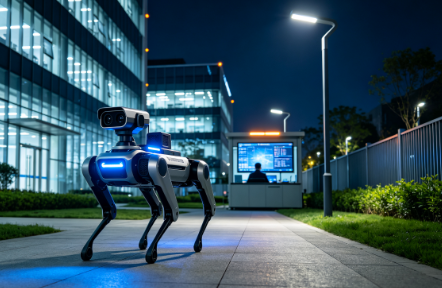
The core value of Zone Charge’s quadruped robot wireless charging solution lies in empowering robots with true autonomous decision-making and perpetual operation. Based on the task queue and its own battery status, the robot can autonomously decide to go to the nearest wireless charging point, “park and charge, leave when full,” integrating energy management into the robot’s intelligent decision-making loop. In all-weather operation scenarios such as industrial inspection, campus security, and emergency rescue, it enables 7×24-hour unattended operation, greatly improving operation continuity and task efficiency. At the same time, in hazardous environments, the design with no exposed interfaces completely eliminates spark and short-circuit risks, providing intrinsically safe power assurance for special operations.
Key Capability Matrix
| Dimension | Zone Charge Solution Performance | Why It Matters |
| Intrinsic Safety | No exposed contacts, physically eliminating spark risk | Prerequisite for access to explosion-proof areas such as petrochemical and coal mines |
| Explosion-Proof Certification | Complies with GB3836 national standard, obtained explosion-proof certificate | Permit for legal entry into hazardous chemical environments |
| Protection Rating | IP67 dustproof and waterproof, magnetic isolation + moisture-proof design | Normal operation in outdoor rain and snow, dusty workshops |
| Foreign Object Detection (FOD) | Can detect coin-sized metal foreign objects and cut power immediately upon abnormality | Last line of defense against overheating and fire |
| Intelligent BMS Linkage | RS485 communication, adaptively adjusts charging curve according to battery status | Protects battery life, prevents overcharge and over-discharge |
| Alignment Tolerance | Magnetic resonance coupling, insensitive to offset | Reduces navigation accuracy requirements, improves charging success rate |
| Fragmented Charging | Park-and-charge during task intervals → can reduce battery capacity demand by ~50% | Weight reduction = greater flexibility, longer effective working time |
IV. Application Scenarios
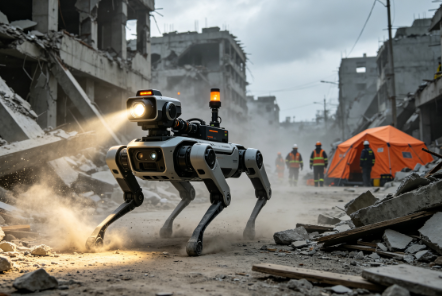
Zone Charge’s quadruped robot wireless charging solution has been widely used in various complex scenarios: in high-risk scenarios such as petrochemical and coal mines, it is equipped with explosion-proof certified modules, completely eliminating spark risks and replacing high-risk manual operations; in power inspection and campus security scenarios, robot dogs can automatically complete fragmented charging during inspection intervals, achieving all-weather uninterrupted patrols; in emergency rescue scenarios, rapid deployment and park-and-charge ensure continuous combat capability; in military and police security scenarios, it can also meet continuous operation needs under high-intensity tasks.
From traditional contact-based inefficient energy replenishment to intelligent perpetual operation enabled by magnetic resonance technology, Zone Charge’s quadruped robot wireless charging solution is redefining the way intelligent robots are powered. In the future, as quadruped robots are deployed more deeply in more scenarios, this solution will provide a solid technological foundation for the unlimited endurance of various “robot companions.